$500 Off Cabinet Painting
Can paint expire? Yes. Even when stored in a sealed container, paint can gradually lose its original quality and eventually become unusable. However, age alone does not determine whether leftover paint is still good. The type of paint, storage temperature, exposure to air and condition of the container all affect how long it remains usable.
If you have an old can of paint in your basement, garage or storage closet, you may be wondering whether it is still suitable for a touch up or another painting project. Using deteriorated paint can result in unpleasant odors, poor coverage, uneven finishes and application problems.
Fortunately, some older paint remains usable when stored properly. Understanding how to recognize spoiled paint, how different formulations age and what storage conditions preserve paint can help you decide whether to use an old can or replace it.
TL;DR
- Paint can expire: Both opened and unopened paint can deteriorate over time, although properly sealed paint generally lasts longer.
- Storage matters: Extreme heat, freezing temperatures, air exposure and moisture can shorten paint’s usable life.
- Check before using: Sour odors, persistent lumps, a jelly like consistency and paint that will not mix properly are warning signs.
- Age is not the only factor: Paint that is several years old may still work if it has been stored properly and passes a thorough inspection.
- Test before painting: Mix the paint thoroughly, apply it to a test surface and allow it to dry before using it on walls, ceilings, cabinets or other finished surfaces.
Can Paint Expire Even If It Has Never Been Opened?
Yes. An unopened can of paint can eventually go bad, even when its lid has never been removed. Sealing a paint container protects the contents from outside air, moisture, dirt and other contaminants. However, it does not stop the chemical and physical changes that can occur during long term storage. Paint is a formulated mixture of several ingredients, including:
- Pigments: Provide color, opacity and sometimes additional properties such as corrosion resistance.
- Binders: Hold the pigment together and form the paint film after application.
- Solvents or water: Control the paint’s consistency and help it spread across a surface.
- Additives: Improve properties such as drying, flow, leveling and resistance to microbial growth.
Over time, these ingredients can separate, settle or undergo changes that affect the paint’s performance. For example, pigments may settle toward the bottom of a container. Some separation is normal and can usually be corrected by stirring. However, severe separation, hardened material or a thick, gelatinous consistency may indicate that the paint has deteriorated.
The container itself also matters. A damaged lid, rusted can or compromised seal can allow air and moisture to enter, even if nobody has intentionally opened it.
An unopened can is not automatically good paint. Its condition and storage history matter just as much as the date it was purchased.
How Long Does Paint Last?
Paint does not have one universal expiration period. Its usable life depends on the formulation, manufacturer, storage conditions and whether the container has been opened.
Some manufacturers provide general shelf life recommendations, while others direct customers to individual product technical data sheets for specific storage requirements.
Benjamin Moore states that most of its opened paint products have a shelf life of approximately two years. Sherwin Williams also recommends checking the condition of stored paint rather than relying exclusively on its age. The following are general planning estimates, not guaranteed expiration dates.
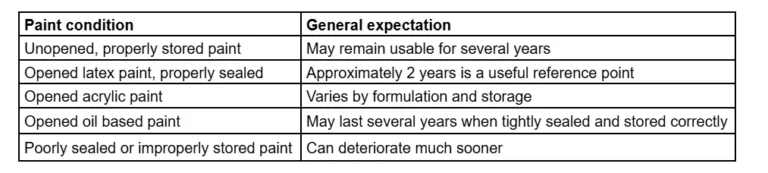
These estimates should not replace the manufacturer’s shelf life information. Specialty coatings, primers, two component products, and certain industrial finishes may have substantially different storage limits.
Does Unopened Paint Last Longer Than Opened Paint?
Generally, yes. An unopened can has a better chance of maintaining its original condition because its contents have not been exposed to outside air, dust, moisture or contaminants from painting tools. Once you open a can, several things can affect its condition:
- Air exposure can cause a surface film to develop.
- Dust, dried paint and debris can enter the container.
- Moisture loss can change the paint’s consistency.
- Bacteria or other microorganisms can contaminate water based paint.
- Repeated opening and closing can weaken the seal.
A can that has been opened and resealed immediately after use may remain usable for years. However, a container left partially open or improperly closed can deteriorate much faster.
Does the Type of Paint Affect Its Shelf Life?
Yes. Different paint formulations respond differently to storage conditions.
1. Latex and water based paint
Latex paint is widely used on interior walls, ceilings, trim and many exterior surfaces. It uses water as its primary carrier. Its water content makes it particularly vulnerable to freezing. Once frozen, the paint may develop clumps or an uneven consistency that cannot be corrected by stirring.
Microbial contamination is another concern. Preservatives help protect water based paint during storage, but their effectiveness can decrease over time.
2. Acrylic paint
Many acrylic paints are water based, although the specific formulation varies by product. Like latex paint, acrylic paint can be damaged by freezing and contamination. Its longevity depends on the binder, additives, container seal and storage environment.
3. Oil based paint
Oil based paint uses an organic solvent rather than water as its primary carrier. It generally does not have the same freezing vulnerability as conventional water based paint. However, it can still deteriorate through solvent loss, oxidation, contamination and improper storage.
A hardened surface layer or thickened material may indicate that the paint is no longer usable.
4. Primer and specialty coatings
Primers, bonding products, metal coatings, masonry coatings and other specialty products should be treated separately.
Some have specific shelf life limits and storage requirements. Two component coatings are particularly important because their individual components can have different expiration periods. Once mixed, they may have a limited working life. Always check the product label and technical data sheet before using an older specialty coating.
Book Free estimate now!
Schedule a free estimate with our experts at Trucoat Painting Plus to gain insights on your cabinet painting project.
How to Tell If Paint Has Gone Bad
An old can of paint does not necessarily need to be thrown away. However, you should inspect it carefully before applying it to a finished surface. Several warning signs can help you determine whether the paint is still usable.
1. Check the Smell
Odor is one of the most noticeable signs of deteriorated paint, particularly water based paint. Fresh paint usually has a recognizable paint smell. Spoiled water based paint, however, may develop a strong sour, rotten egg or mildew like odor.
This can happen when microorganisms contaminate the paint during storage. If the paint has an unusually strong rancid or rotten smell, do not try to cover it with another product or mix it with fresh paint. Dispose of it according to local requirements.
Avoid deliberately inhaling fumes to investigate an unfamiliar odor. If the container smells strongly when opened, keep the area ventilated.
2. Look for Lumps and a Jelly Like Consistency
Paint should become reasonably smooth and uniform after thorough stirring. Some settling is normal, especially when a can has been sitting untouched for months or years. Pigments and other solid ingredients naturally settle toward the bottom. The important distinction is whether the settled material can be mixed back into the liquid. Watch for:
- Hard lumps that remain after stirring.
- Rubber like pieces or thick clumps.
- A gelatinous consistency.
- Dried material throughout the paint.
- A texture that resembles cottage cheese rather than smooth liquid paint.
These conditions suggest that the paint may have deteriorated. Do not assume that adding water or paint thinner will restore spoiled paint. Thinning changes consistency, but it does not reverse chemical deterioration or microbial contamination.
3. Look for Separation That Does Not Disappear After Mixing
When you open an old paint can, you may find a layer of liquid sitting above a thicker mass of pigment. This is not necessarily a problem. Paint manufacturers formulate products so their ingredients remain dispersed, but some settling naturally occurs during storage. Stirring redistributes the ingredients.
Try mixing the paint thoroughly with a clean paint stir stick. If the liquid and pigment blend into a consistent mixture, the separation may have been normal settling.
However, paint that remains separated, develops unusual clumps or refuses to return to a uniform consistency should not be used.
4. Inspect the Can for Rust, Leaks and Damage
The condition of the container can reveal potential storage problems. Examine the following:
- Rust: Corrosion around the rim or inside the can can compromise the container.
- Damaged lid: A loose or warped lid may have allowed air to enter.
- Leaks: Dried paint around the bottom or sides may indicate a compromised seal.
- Bulging: A swollen container can indicate gas buildup or a chemical reaction.
- Severe corrosion: A badly rusted container may contaminate the paint.
Do not open a swollen or pressurized container casually. Handle it carefully and contact the manufacturer or an appropriate local waste management authority for instructions. A can that looks fine on the outside is not necessarily proof that the paint inside is usable.
5. Check Whether the Paint Dries Normally
Paint can look acceptable in the can but still perform poorly after application. Once you have inspected and thoroughly mixed the paint, apply a small amount to a suitable test surface. Observe the following:
- Does the paint spread smoothly?
- Does it leave a reasonably uniform film?
- Does it develop unusual lumps or rough patches?
- Does it dry within the normal timeframe specified by the manufacturer?
- Does the dried coating have an unusual appearance or persistent odor?
Allow the sample to dry according to the product instructions. Do not judge it immediately after application. If the paint remains tacky much longer than expected, dries unevenly or develops an abnormal finish, do not use it for the main project.
Important: A successful test patch is useful, but it does not guarantee long term adhesion, durability or compatibility with an existing coating. For demanding applications, the manufacturer’s guidance takes priority.
Book Free estimate now!
Schedule a free estimate with our experts at Trucoat Painting Plus to gain insights on your cabinet painting project.
What Happens If You Use Expired Paint?
Using deteriorated paint can create problems that are not always visible immediately. The most common issues involve application, appearance, drying and the performance of the finished coating.
1. Poor Coverage
Paint that has lost its original consistency may not spread or cover surfaces as intended. You might notice that it takes more coats to achieve an even appearance. In some cases, pigment distribution becomes inconsistent, leaving certain areas lighter or darker than others.
2. Uneven Color and Finish
Paint contains pigments and binders that work together to create the final color and surface appearance. When those ingredients no longer mix properly, the coating may appear blotchy or inconsistent.
This is particularly noticeable on large walls, ceilings, cabinets and other surfaces where uniformity matters.
3. Longer or Uneven Drying Times
Deteriorated paint may not dry within the normal timeframe. The surface could remain tacky, develop an uneven film or dry differently from the surrounding painted areas.
This can become a problem when applying additional coats because the next coat may not perform as expected.
4. Persistent Unpleasant Odors
Spoiled water based paint may release an unpleasant odor during and after application. Simply opening windows or increasing ventilation does not make contaminated paint suitable for use. If the paint smells strongly sour or rotten, discard it rather than applying it indoors.
5. Problems With Adhesion and Durability
Paint needs to form a stable film after application. If its binder or other ingredients have deteriorated, the resulting coating may not perform as intended.
Possible problems include poor film formation, weak adhesion, inconsistent sheen and premature coating failure. For this reason, old paint should not be used on surfaces where a dependable finish is important simply because it looks acceptable after stirring.
Does Paint Go Bad If It Freezes?
Yes, freezing can permanently damage many types of paint, particularly conventional water based latex and acrylic products. Water based paint contains water as its primary carrier. When that water freezes, the paint’s original emulsion structure can break down.
An emulsion is a mixture in which ingredients that normally do not combine easily are dispersed throughout a liquid. In paint, this structure helps the binder and other ingredients remain properly distributed.
Freezing can disrupt that structure, causing the paint to separate into clumps or develop a grainy consistency. According to Hempel’s technical storage guidance, waterborne coatings should not be exposed to frost because freezing can irreversibly destroy them.
Can You Use Paint After It Has Frozen?
It depends on the product and its condition, but you should be particularly cautious with water based paint. If you suspect that a can has frozen:
- Move it to a temperature controlled indoor location.
- Let the paint gradually warm to room temperature.
- Inspect the consistency before attempting to mix it.
- Stir it thoroughly and check for persistent separation or clumping.
- Consult the manufacturer if you have concerns about the paint’s condition.
Do not assume that paint is usable simply because it has thawed. Some solvent based coatings respond differently to low temperatures, but they also have product specific storage requirements. If the manufacturer identifies freezing as a reason for disposal, follow that recommendation.